
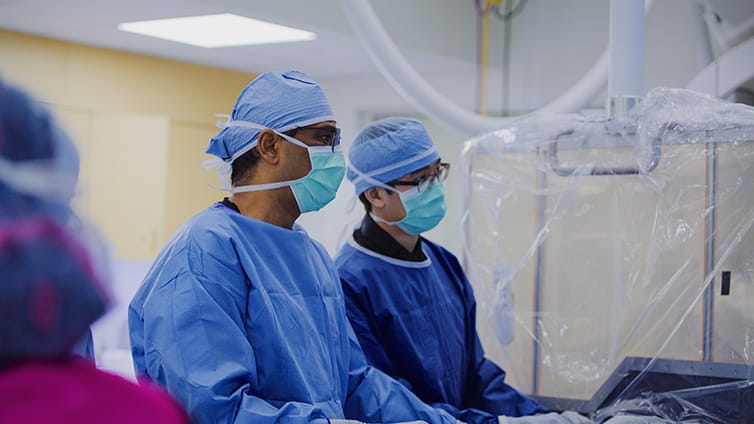
If you have chest pain, shortness of breath or an irregular heartbeat, your doctor may want to take a closer look at your heart. To diagnose a cardiac condition—your doctor may send you to the cath lab.
Unless you’ve been to the cath lab before, you may not know what it is or what happens there. Puvi Seshiah, MD, an interventional cardiologist with The Christ Hospital Physicians-Heart & Vascular, explains what happens in the lab, why you may need to go if referred, and what to expect.
What Is the Cath Lab?
The cath lab is also called the cardiac catheterization lab. But the name is misleading. It is not a lab with specimens and test tubes. Instead, it’s a procedural area in the hospital where interventional cardiologists perform minimally invasive procedures to diagnose and treat heart conditions.
Cardiac catheterization helps them answer your health questions. For this procedure, they make a small incision in your wrist or groin. Then, with X-ray guidance, they thread a thin tube (a catheter) through your vein to your heart. Your doctor can use cardiac catheterization to:
- Capture pictures of your heart
- Examine your heart for coronary artery disease
- Measure your blood flow, oxygen level, and pressures in your heart and lungs
- Treat heart blockages, heart failure or valve disease
Reasons to Go to the Cath Lab
Your doctor may send you to the cath lab for a wide variety of reasons, Dr. Seshiah says.
“Most of the time we send patients to the cath lab to get a better understanding of their symptoms or to provide a better treatment,” he says. “These procedures can guide us in diagnosing diseases like coronary disease, heart failure, pulmonary hypertension or valve problems.”
To get this necessary information, Dr. Seshiah says your doctor will recommend an appointment if you experience:
- Abnormal heart rhythm
- Discomfort in your legs when you walk
- Fatigue
- Pain in your arm, chest or shoulders when you walk
- Shortness of breath
- Swelling in your legs or abdomen
- Abnormal findings from other cardiac tests
Procedures Performed in the Cath Lab
Cardiac catheterization allows your doctor to perform other important procedures, Dr. Seshiah says. Some may be diagnostic tests. Others may treat your condition.
These additional procedures include:
- Coronary angiography: This diagnostic test occurs during catheterization. Your doctor injects contrast dye through the catheter to reveal any narrow or blocked arteries on a diagnostic image (coronary angiogram).
- Angioplasty: Also called percutaneous coronary intervention, this procedure inflates a tiny balloon at the end of a catheter to open your blocked arteries. Then, your cardiologist places a small, hollow mesh tube (coronary stent) to keep your blood vessel open.
- Heart pump: Your cardiologist uses a catheter to implant a computer-controlled balloon pump or a mechanical ventricular assist device to regulate help treat heart failure and cardiac shock.
What to Expect During Your Cath Lab Procedure
At The Christ Hospital Health Network, we design your procedure preparation to keep you as comfortable as possible, Dr. Seshiah says. A nurse from the cath lab will complete your blood work and perform an electrocardiogram to record your heart signals. Before taking you to a procedure room, they will start an IV and shave your groin or wrist.
Once you are in the procedure room, your care team will:
- Give you a gown to wear
- Offer a blanket to keep you warm
- Sterilize your groin or wrist
- Administer sedation to keep you comfortable but awake
Your cardiologist uses X-ray imaging and a contrast injection to see your arteries and veins during your procedure. Doing this also lets them see the catheter clearly as it moves toward your heart. Depending on your procedure, Dr. Seshiah says you may be in the cath lab for 60 to 90 minutes from prep to finish.
What to Expect After Your Cath Lab Procedure
Although cath lab procedures are minimally invasive, you will need several days to recover fully, Dr. Seshiah says.
“We place catheters in arteries for these procedures. When they come out, there’s a small hole in the artery about the size of a pen refill,” he says. “These entry points can bleed a lot. So, we take great care to ensure the arteries close before we send you home.”
After your cath procedure, you should follow these restrictions:
- Avoid lifting anything over five pounds for up to five days
- Don’t drive for two days
- Limit stairs for a day or two
- Some of these restrictions may be longer based on the procedure performed.
When to Seek Medical Attention
Cardiac catheterizations and other cath lab procedures are very safe, Dr. Seshiah says. But some complications are possible. Contact your doctor if you experience:
- Bleeding from the wrist entry point that won’t stop with firm pressure
- Dizziness
- Drainage from your incision
- Fever
- Heart rate that is fast, irregular or slow
- Increased bruising around your incision
- Numbness or tingling at the entry point
Seek immediate medical attention if you experience:
- Any bleeding from a groin entry point
- Bleeding from a wrist entry point that you can’t stop within 15 minutes
- Chest pain
Advanced Care at The Christ Hospital
The cath lab care team at The Christ Hospital includes 18 specially trained providers. We’re uniquely positioned to perform the full range of common to complicated minimally invasive heart procedures, Dr. Seshiah says.
“At The Christ Hospital, we excel in performing the most intricate catheterization procedures compared to any other hospital in the region, as Dr. Seshiah explains. We undertake high-risk procedures, such as opening arteries that are completely blocked, and complex valve repairs and we perform these procedures more frequently than any other institution.
To deliver the best outcomes, our providers use leading-edge technologies, like medicated stents and balloons. These tools help prevent future blockages. At Christ Hospital we are able to treat patients with next generation devices, some of these are through unique FDA approved device trials.
Get the Care You Need
If you’re worried about a possible heart condition, don’t wait to make an appointment. Call 513-206-1270 or fill out our online appointment form below to schedule with one of our experts.
Frequently Asked Questions About Cath Labs
Q: Will I be awake for my cath lab procedure?
A: Yes, but we will give you medication to reduce your pain and keep you comfortable. We administer a local anesthetic before making the incision to insert your catheter. And we give you mild sedation before the procedure. This medication helps you relax, but you will be awake.
Q: Why is the cath lab so cold?
A: Cool temperatures help our medical equipment run more efficiently. Also, a cooler room keeps your infection risk as low as possible.
Q: Will I need to stay in the hospital overnight after my procedure?
A: Most people can go home the same day unless your doctor requests an overnight stay in the hospital. It is important to have a responsible adult to stay with you overnight, when being discharged the same day.
Featured in This Post
Tags
Expert
 Puvi N. Seshiah, MD
Interventional Cardiology, Cardiovascular Disease
 An Unexpected Discovery: Philip’s Coronary Microvascular Disease StoryWhile leading an EMS conference, Philip Dietz heard something unexpected: his own symptoms. Then a second opinion from leading heart experts helped him find answers at last.
 Built to Last: The Christ Hospital Health Network Is Shaping the Future of Heart SurgeryFor more than five decades, The Christ Hospital Health Network has shaped the region's cardiovascular landscape and earned recognition as one of the nation's leading heart programs.
- Patient with “No Options” Undergoes Innovative Heart SurgeryBob Siemer needed a fourth heart surgery to treat chronic total occlusion. Providers at The Christ Hospital treated him with an innovative technique.
- This February, Put Your Heart FirstFebruary is American Heart Month – the perfect time to shine a spotlight on heart health and on the importance of heart and vascular screenings.
- February Is American Heart MonthSee how The Christ Hospital, Cincinnati’s Heart Hospital, is preparing for February-American Heart Month.
- How Elise Got Back in the Game After a Third OpinionAfter prolonged pain following knee repair, standout soccer player Elise Haller finally found answers, and relief, from a third opinion and expert vascular surgery.
- Holiday Hustle or Heart Hazard? Tips to Stay Heart Healthy This SeasonThe holidays are great, but they can also be stressful and take a toll on your mental health and your body. In some cases, the added stress can increase the risk of heart attack and stroke, so let’s talk about how to stay healthy.